



World Stroke Day 2026
World Stroke Day is observed on 29 October every year. The World Stroke Organization's theme for 2026 is “Every M1nute Counts”, a call to learn the signs of stroke and #ActFAST, because the sooner treatment begins, the more of the brain can be saved.
What does “Every M1nute Counts” mean?
Every two seconds, someone in the world has a stroke. A stroke cuts off the supply of blood and oxygen to part of the brain, and the first hour, often called the golden hour, is critical.
The faster the signs are recognised and help is called, the sooner treatment can begin, and the better the chance of survival and a near or full recovery. That is the idea behind this year's campaign: learn to spot stroke, act as fast as stroke does, and know that what you do today could change a life tomorrow.
- 12 millionpeople have a stroke every year worldwide
- 1.9 millionbrain cells die every minute a stroke goes untreated
- 1 in 4people will have a stroke in their lifetime
- 2 in 3survivors live with long term complications or disability
Spot a stroke and act FAST
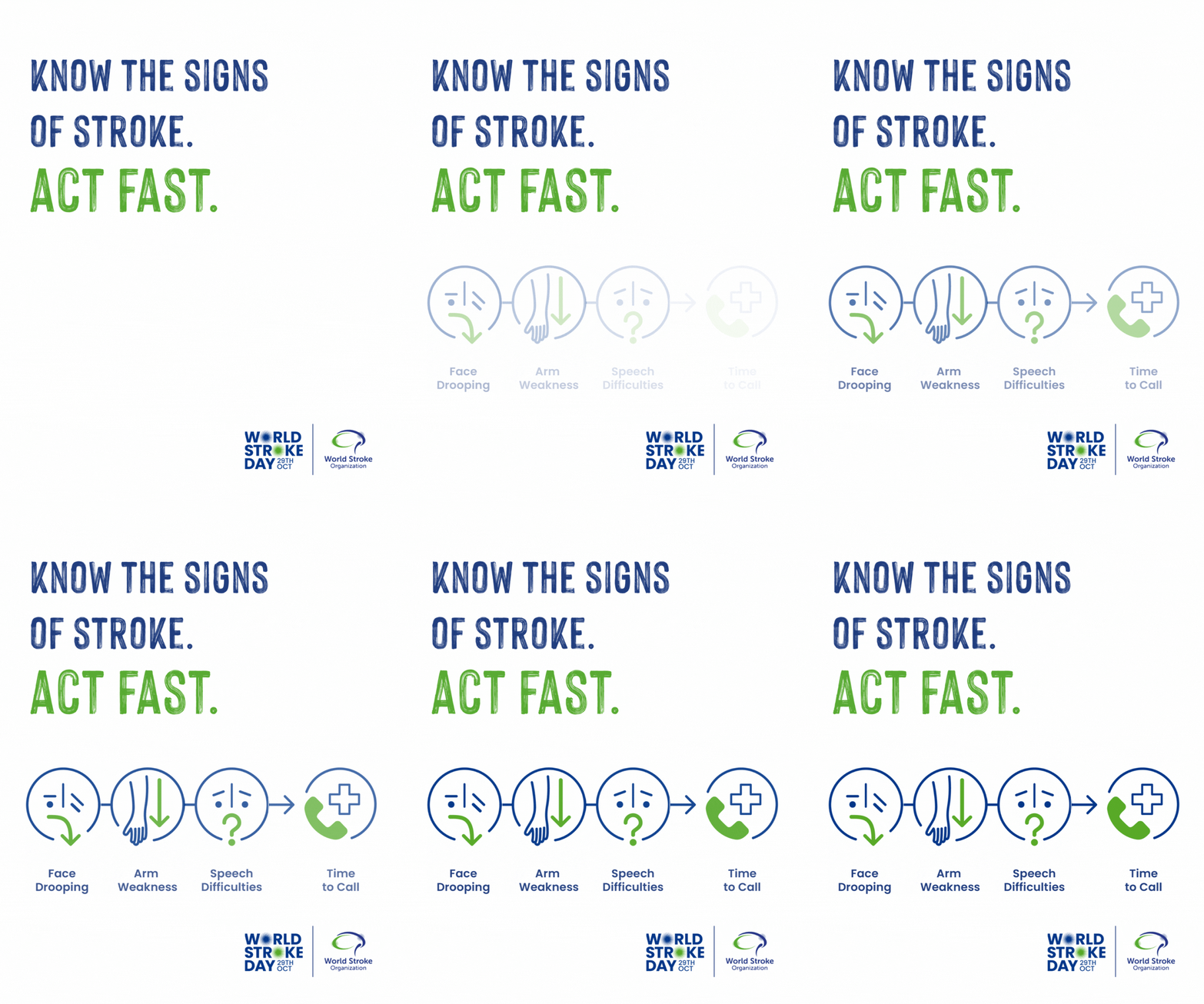
Face
One side of the face droops, or the smile looks uneven.
Arm
One arm is weak or numb, and the person cannot raise both arms.
Speech
Speech is slurred, confused or hard to understand.
Time
Call for emergency help at once and say it may be a stroke.
What to do while help is on the way
Do
Note the time the first symptom appeared, or when the person was last seen well. Doctors use this to plan treatment.
If the person is drowsy, lay them on their side and keep the airway clear.
Don't
Do not give food, water or any medicine, including aspirin. Some strokes are caused by bleeding.
Do not wait to see if the symptoms pass. Symptoms that settle still need urgent assessment.
Types of stroke
Every stroke cuts off blood to part of the brain, but not always in the same way. Doctors need a brain scan to tell which type it is, because the treatment for each is different.
-
Ischaemic stroke
A clot or narrowed artery blocks blood flow to part of the brain. This is the most common type of stroke.
-
Haemorrhagic stroke
A blood vessel in or around the brain bursts and bleeds. It is often linked to high blood pressure or a weak spot in an artery called an aneurysm.
-
Mini stroke (TIA)
A transient ischaemic attack causes stroke signs that go away, often within minutes. It is a warning that a major stroke may follow and needs medical assessment the same day.
Who is at risk, and how to lower it
Most strokes are linked to risk factors that can be checked and controlled. Small, steady changes lower the risk at any age.
Blood pressure
Check it regularly. The biggest single risk. If it is high, take medicines every day as advised, even when you feel well.
Diabetes
Keep sugar in range. Keep blood sugar within the range your doctor advises, and keep up regular checks.
Tobacco
Stop, at any age. Cigarettes, beedi and chewed tobacco all raise the risk. Stopping lowers it, whatever your age.
Cholesterol
Know your numbers. High cholesterol narrows arteries over time. Follow the treatment plan your doctor gives you.
Heart rhythm
Check an irregular pulse. Atrial fibrillation can form clots that travel to the brain. Get a pulse that feels irregular checked.
Daily habits
Move more, less salt. Regular activity and a balanced diet help keep blood pressure and weight in check.
Stroke does not wait for old age.
Stroke also affects young adults. A sudden weak arm, drooping face or slurred speech in a younger person needs the same urgent response.
Life after stroke, for survivors and families
Recovery is different for everyone. With the right support, many people regain a great deal of what the stroke took away.
Recovery takes time
Progress is often quickest in the early weeks, and many people keep improving for months with regular rehabilitation.
A safer home helps
Clear walkways, good lighting and grab rails in the bathroom reduce the risk of falls during recovery.
Feelings matter too
Low mood, frustration and tiredness are common after a stroke, for survivors and carers alike. Talk about them with the care team, and let family share the load.
Preventing another stroke
Take medicines as prescribed, keep follow up visits, and keep blood pressure, sugar and cholesterol under control.
Stroke care at Mar Sleeva Medicity Palai
At Cherpunkal, Kottayam, the Centre of Excellence in Neuro Sciences and the Department of Physical Medicine and Rehabilitation care for stroke patients from the first call for help through to recovery at home, for families from Palai, Kottayam and across Central Kerala.
-
Emergency and diagnosis
- Emergency Stroke Ambulance Service
- Round the clock neuro emergency care
- CT and MRI brain imaging through our radiology services
- Transcranial Doppler evaluation
-
Treatment
- Thrombolysis, clot dissolving treatment
- Mechanical thrombectomy, catheter removal of a clot
- Interventional neuroradiology, including aneurysm coiling and vascular intervention
- Neurovascular surgery: aneurysm clipping, AVM and cavernoma removal, carotid endarterectomy and bypass surgery for moyamoya disease
- Neurocritical care
-
Recovery
- Stroke rehabilitation programme, starting from the hospital bed
- Physiotherapy to stand and walk again, and arm, hand and shoulder recovery
- Speech, language and swallowing therapy
- Spasticity care, memory, thinking and mood support
- Help with daily routines and rehabilitation continued at home
Read more about our stroke care services.
Are you ready to become a Stroke Spotter?
Watch short videos, take the quiz and test your reaction time in the World Stroke Organization's #ActFAST challenge, then share your Stroke Spotter badge with family and friends.
Frequently asked questions
When is World Stroke Day 2026?
World Stroke Day 2026 is on Thursday, 29 October. It is observed on 29 October every year and is led by the World Stroke Organization.
What is the theme of World Stroke Day 2026?
The theme is “Every M1nute Counts”. It asks everyone to learn the signs of stroke and #ActFAST, because every minute without treatment costs brain cells.
What are the signs of a stroke?
Remember FAST: Face drooping on one side, Arm weakness, Speech that is slurred or confused, and Time to call for emergency help.
What should I do if someone is having a stroke?
Call for emergency help at once and say it may be a stroke. Note the time the symptoms began, and do not give food, water or any medicine while you wait.
Where can I get emergency stroke care near Palai and Kottayam?
Mar Sleeva Medicity Palai at Cherpunkal, Kottayam, provides emergency stroke care through its Centre of Excellence in Neuro Sciences. For a stroke emergency, call 82816 99242.
What is a mini stroke?
A mini stroke, or transient ischaemic attack (TIA), causes stroke signs that go away, often within minutes. It is a warning sign of a major stroke and needs medical assessment the same day.
Can young people have a stroke?
Yes. Stroke is more common with age, but it also affects young adults. The signs and the need for urgent treatment are the same at any age.
Medically reviewed by Dr. Sareesh Kumar M K, MBBS, MS, MCh (Neurosurgery), Senior Consultant and Head, Neurosurgery and Spine Surgery, Mar Sleeva Medicity Palai. Last reviewed: 16 October 2026.
- World Stroke Organization. World Stroke Day 2026 Campaign Toolkit.
- World Stroke Organization. World Stroke Day 2026: Every M1nute Counts.
This page is for general health awareness and does not replace medical advice. If you suspect a stroke, seek emergency care immediately.


